Tuesday, November 29, 2011

Overview of gender/race/class

  Before I took this class, I had a very narrow viewpoint of gender, race, class and sexual orientation in the media.  I thought that there was no representation of these things in media except for incorrect portrayals that were influenced by the society.  The media seems to have influenced a white male dominated society. Below are images depicting models from Abercrombie and Finch.

  As you can see, all of these models have things in common.  They are all white, rarely is there a model with dark skin in this company’s advertisements.  The men depicted in these images are very masculine, and seem as if they want to be dominant.  The females in the ads, however, seem as if they are weak and vulnerable.  Given what we know about hegemony, it would seem as if that is what society wants us to think.  

  Hegemony is described as a group in society that has dominance over others.  Given that media tends to depict dominant dominate white men, it might be safe to say that heterosexual, white men are what is expected to be the dominate group. Shows that aired in the 50’s are a good example of this.

 
  “Leave it to Beaver” was a very good example of a show that had a “perfect family.”  The children were well behaved, and the mother was a housewife.  The father was a white man that brought home the money for the family.  He was also the one to give orders to the members of his family, and discipline the children when necessary.  Society wanted the public to think that this was the way that all families should be.  As such, shows like this were very common in society.  They wanted everyone to have a family that was run by a male, and these families were expected to be white.

  I view that all of the above information is terrible.  Men of a specific race are expected to be the dominant group.  This is immoral because men are not always the dominant ones.  There have been plenty of examples of women filling the role of the dominant figure.  If society continues to hold this to be ideal then men will always be thought of as dominant.   

Monday, November 28, 2011

Sexual Orientation- Xandire from Drawn Togeather

  The LBGRTQ community has always been one of the tough subjects in media.  Whether it was representation in radio, television, or in videogames, it always seemed to be offensive.  As time went on, there have been more accurate portrayals of the LBGTQ community on television.  Such positive portrayals include Kurt from Glee, whose “coming out” story has been central to his character.  Other positive portrayals are Will from Will and Grace, who was a professional business man. Reality shows, such as The Real World, often have at least one openly gay cast member.   It is from this reality show, that a rather offensive LBGTQ character was born.

   The animated show Drawn Together was produced by Comedy Central, as an animated Real World.  It featured parodies of famous animated characters all set in a reality show.  One of the characters was based on Link, the protagonist from the Legend of Zelda series.  It has always been rumored amongst fans that Link was gay.  As such, the character based on him was openly gay.  The character, Xandir, started the series “in the closet.”  By the third episode, he started to notice that he was not interested in any of the attractive women that he was now living with; in fact, he was acting like the women that he was living with.  After being in denial for most of the episode, Xandir accepted that he was gay.  This then lead to offensive behavior on his part.


  After Xandire “came out,” he began to throw his sexuality around.  Everything he said had a suggestive meaning to it.  He would also hit on any man that he saw, regardless if they were homosexuals or not, going as far as tricking straight men into having sex with him.  This made his character a stereotypical gay man as perceived in the media.  He was promiscuous, and effeminate.

 
  While I was a fan of the show, this character was very offensive to me.  I was dealing with the pain of coming out to my family at the time that this show aired.  As such, I thought that if I did come out, then I was going to be expected to act like Xandire.  I am not promiscuous, as I view it to be immoral.  While I do talk suggestively at times, it is only when appropriate for humor and not everything that I say.  While the show was made with the thought of being funny, there was nothing humorous about being misrepresented.

 
Wikipedia. (2011, November 26). Drawn Tpgeather. Retrieved 29 November, 2011, from Wikipedia: http://en.wikipedia.org/wiki/Xandir#Xandir_P._Wifflebottom

Sunday, November 27, 2011

Social Class- The P.J.'s

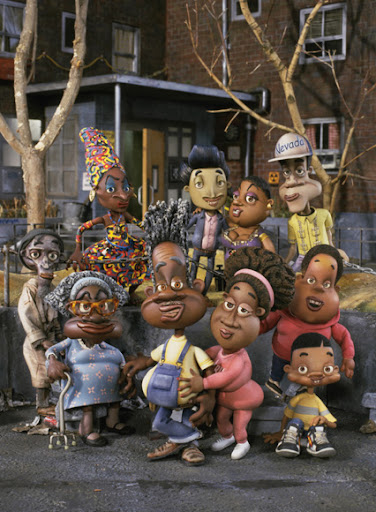
  Social class is present in most television shows today.  Sometimes, it is hidden while other times it is rather obvious.  Some of these shows depiction of class might even be considered offensive.  One such show that might be considered an offensive portrayal of social class is “The PJ’s” which used to air on FOX.


  Taking place in the projects in an unnamed city, “The PJ’s” ran for three seasons.  The show was done in a stop –motion animation, and took a long time just to make one episode.  The show had a pretty straight forward premise in the first few episodes.  An African American family faced the challenges of living in the projects, while trying to work their way up in society and move into a better area in the city.  As the show went on, however, the creators decided that the two main characters, Thurgood and Muriel Stubbs, should focus on being more comedic and less about moving out of the projects.  


  Above is the main character, Thurgood.  He was stereotypical superintendent of a project building as is always demanding rent, and doing virtually nothing to improve the flaws that were present in the building.  He would also act politically incorrect by behaving inappropriately, and not being afraid to admit that he was not well educated.  He would also say random names of famous African American people to express his emotion.  For example, he once said, “Sweet Macy Gray,” to express being surprised.  He is contradicted, in appearance and behavior by his wife, Muriel.

 
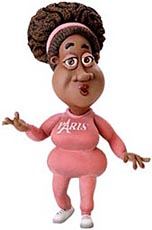
  Above is Muriel Stubbs.  While she looks like a typical African American woman from the projects, she is much more down to Earth than her husband.  She was able attended a privet school that was made up of mostly white students, due to her good academics.  When she graduated high school, she settled for what she could get, and married Thurgood, fully aware that he was just a superintendent of the local projects.  She has, however, shown that she can be just as dimwitted as Thurgood and the rest of the characters on more than one occasion.

  While I was a fan of the show when it aired, I always felt bad for laughing at it.  I understand that it was done for humor, but people I talked to at school about it seemed as if it was a touchy subject.  African American people showed great resistance to this show until it was eventually cancelled.  Eddie Murphy, who voiced Thurgood for most of the run of the series, left the show for a while, as the producers would not listen to any suggestions that he made to help make the show less offensive.  Even though it was all done in the name of comedy, FOX should have taken the views of the public into consideration. 


The PJ's. (2007, May). The PJ's. Retrieved November 2011, from tripod.com: http://tspwr.tripod.com/characters.html
The PJ's. ( 2011 , July 5). The PJ's. Retrieved November 28, 2011, from Wikipedia: http://en.wikipedia.org/wiki/The_PJs

Saturday, November 26, 2011

Videogames- Race Equality

     As a gamer, I have always noticed that certain races were not present in the games that I play.  It was not something that I noticed when I was younger, but around the age of 13, I saw that African Americans were either not present, or there was only one African American character in the game.  It seemed rather unrealistic that everyone that was alive in these fantasy worlds were white or Asian.  Even the Pokemon games were guilty of this until just recently.

 
    Above is Lenora, she is known among fans as, not only the first African American main character in the Pokemon series, but also the very first African American Gym Leader in the Pokemon games.  In the Pokemon Universe, a Gym Leader is a very powerful Pokemon trainer that must be defeated to prove a trainer’s skill as a Pokemon trainer.  When Lenora’s artwork was revealed to fans in Spring 2010, fans quickly theorized what her role in the series would be.  When it was revealed that she was going to be a Gym Leader, African American fans of the series were excited, but worried at the same time. 
        
    African American fans were afraid that Lenora would act like stereotypical African American woman, which the media is known for doing with characters like this.  Once the games were released, however, everyone was pleased with the final product.  In the game, Lenora was revealed to be a world renowned archaeologist who owned a museum where she stored her findings.  She also spoke very professionally, and was always excited when speaking.  Below is a recording of Lenora’s Gym battle from the game.  In this recording, her mannerisms match what is described above.


      Even though it is good that there is finally a positive African American character in the Pokemon games, one question remains.  Why did it take so long for Nintendo to create an African American character for this series?  Pokemon debuted in 1997 and Lenora’s game did not come out until early 2011.  Nintendo must not have thought that a character like Lenora was needed, but I thought that it seemed rather irresponsible for them wait this long to create a character like her.


Bulbapedia. (2011, November 5). Lenora. Retrieved November 27, 2011, from Bulbapedia: http://bulbapedia.bulbagarden.net/wiki/Lenora